
QR Codes for Print Marketing in 2026: Track Every Flyer, Billboard, and Business Card
Last updated Jul 3, 2026
On this page
- Why print is measurable again
- What a trackable QR actually does, plumbing-level
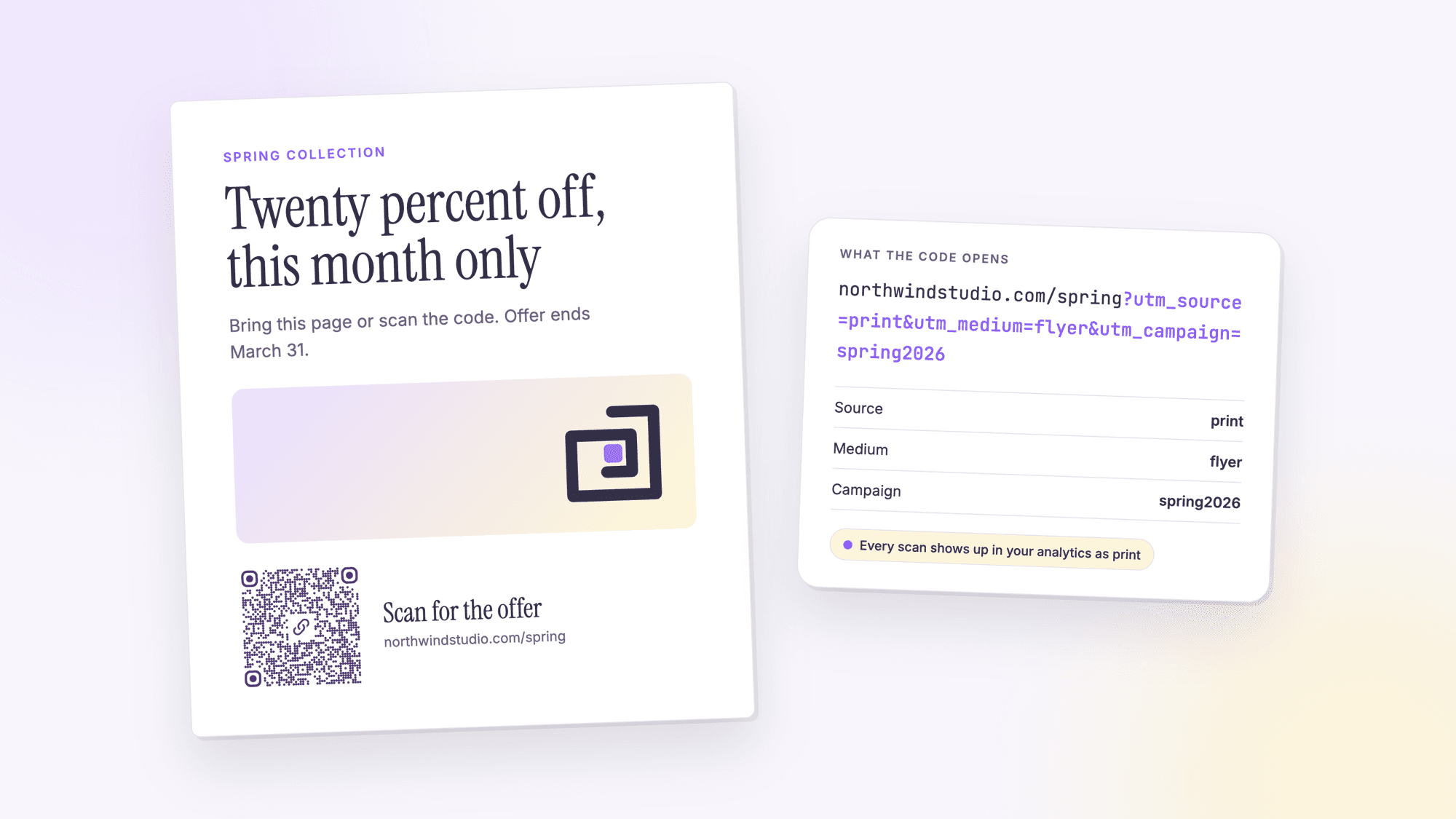
- UTM construction for print, the short version
- A/B testing print: the city-A versus city-B pattern
- Minimum scannable size: the rule that everyone gets wrong
- Contrast and quiet zone: the law of QR design
- Where the QR goes on the page
- Five print campaigns where QRs make a measurable difference
- The destination page is half the campaign
- What I'd skip
- Common mistakes I keep seeing
- Common questions about QR codes for marketing campaigns
Print marketing has quietly become one of the better-performing channels in a lot of marketing mixes, and the data backs it up. Lob and Comperemedia's 2025 State of Direct Mail report, surveying 405 marketing professionals at large North American companies, found that 79 percent of executives rank direct mail as their single best-performing channel, and 90 percent say it measurably lifts engagement across their digital channels too. The number that used to make finance teams nervous, whether a printed piece is even worth tracking, has an answer now: a QR code with a UTM-tagged destination.
Why print is measurable again
The Association of National Advertisers' 2023 Response Rate Report found direct mail sent to house lists converts at 15.6 percent, and even cold prospect lists convert at 10.8 percent. For context, that house-list mail carried a 161 percent ROI in the same report, the highest of six channels tested, ahead of email to house lists (44 percent), branded paid search (38 percent), and social media (21 percent). On the consumer side, Lob's companion Consumer Insights report found 84 percent of people read their mail the same day it arrives, up from 70 percent a few years earlier, and about two-thirds say relevant, personalized mail is what makes them actually act on it.
Add the rising cost of paid social, the erosion of audience targeting after iOS 14.5 and the ongoing changes to third-party cookie behavior, and the relative economics of print look better every quarter. What changed in the last few years is that you can measure a printed touch with the same rigor as a paid click. The mechanism is a QR code with a UTM-tagged destination, a short vanity URL printed below it as a fallback, and a landing page built to mirror the print creative.

What a trackable QR actually does, plumbing-level
A bare URL printed on a poster is invisible to analytics. Anyone who types it or hits the homepage looks identical to direct traffic. You cannot tell the billboard from the bus stop from the magazine spread.
A trackable QR is four things stitched together. A short URL on a redirect domain you control. UTM parameters appended to the destination. A server-side redirect that fires before the user lands. A scan counter that logs timestamp, rough geography, and device type. Mailchimp, Bitly, Rebrandly, and most QR platforms bundle these. The output is a row in your analytics that looks likesite.com/offer?utm_source=qr&utm_medium=print&utm_campaign=spring-2026and the CFO can compare CPA across billboard, magazine insert, postcard, conference flyer, and Google search in the same dashboard. Apples to apples.
Use a URL QR code with the full tagged URL inside. If the campaign URL might change after the print run goes live, switch to a dynamic QR with a short redirect domain. Then you can swap the destination without reprinting 10,000 magazine inserts.
UTM construction for print, the short version
Five parameters cover almost every print use case. Pick a convention and write it down before anyone designs anything.
utm_source is the physical channel: billboard, magazine, postcard, flyer, business-card, conference-booth. Lowercase, hyphenated, no spaces.
utm_medium is the broad format: print, mail, ooh, event. Keep this list short. Three or four values, never twelve.
utm_campaign is the launch or quarter: spring-2026, q3-launch, holiday-2025. Tie it to a Notion page that documents what the campaign was so the analyst three quarters later can decode it.
utm_content is the variant or location: hwy-101-northbound, vogue-may-page-47, postcard-headline-a.
utm_term is the A/B variable if you are running one: headline-a vs headline-b, offer-15off vs offer-free-trial.
Be ruthless about consistency. If your team writes "billboard" sometimes and "OOH" other times, your dashboard will lie to you and you will make bad budget decisions for the rest of the year.
A/B testing print: the city-A versus city-B pattern
Print does not have to be the static medium it pretends to be. The pattern that works.
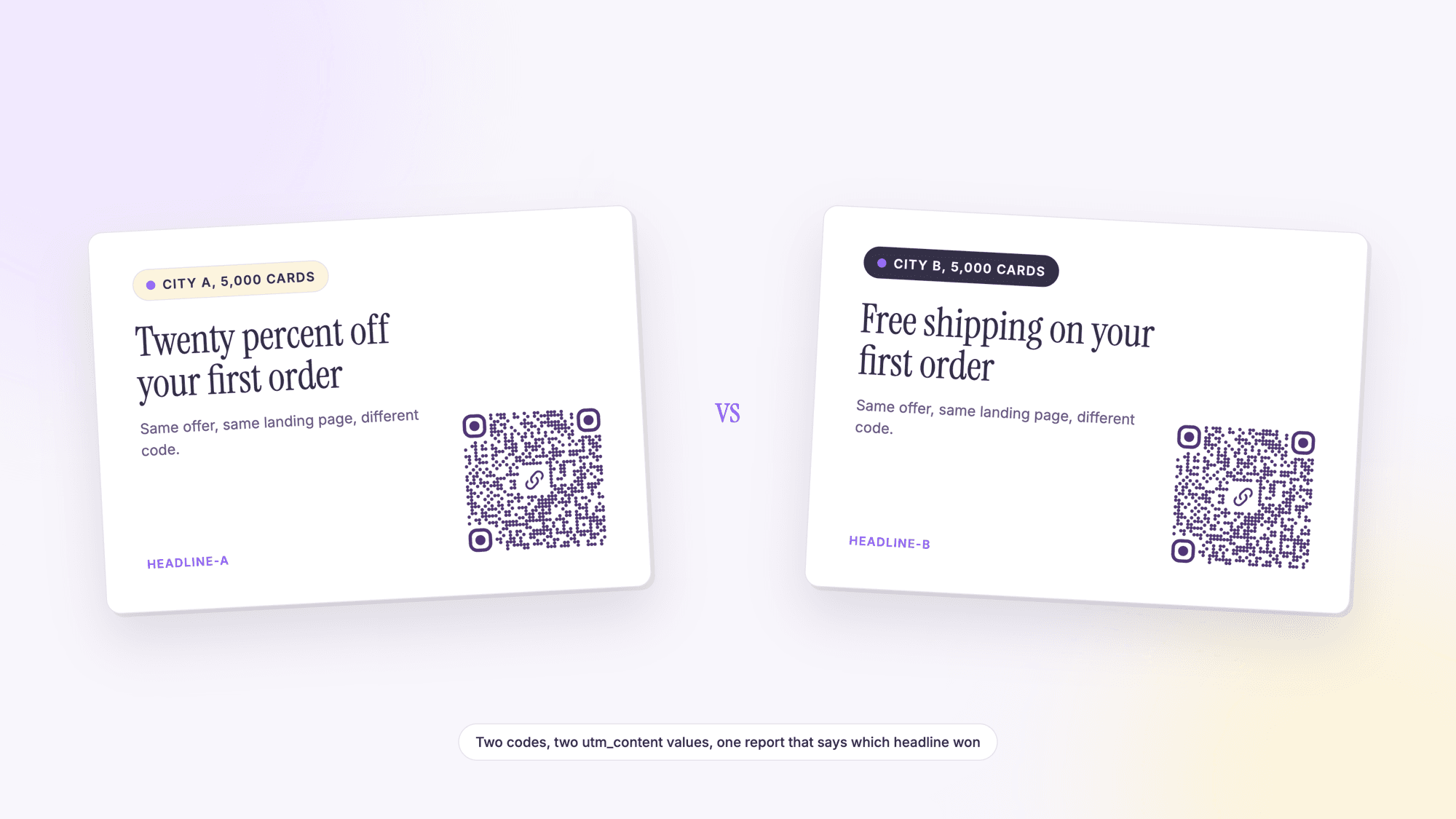
Pick two cities with comparable demographics and audience sizes. Run the same campaign in both, with different creative. Version A in Denver, version B in Phoenix. Different QR codes pointing at the same destination with different utm_content tags. Run for four to six weeks. Compare conversion rates and CPA. You now know which creative pulled, with a real-world signal that no focus group can match.
For direct mail, the split is even easier. Print two postcard versions, mail them randomised across the same ZIP codes, track QRs. I have seen response rates double from a headline change alone. Total cost to find that out: two thousand US dollars of printing and one afternoon of analytics setup. That is roughly one week of a Google Ads test budget at a mid-size company.
Minimum scannable size: the rule that everyone gets wrong
The rule of thumb is the QR should be one-tenth of the expected scan distance. The translation to practical sizes.
Business card at arm's length (about 12 inches). Minimum 0.8 inches (2 cm) square. Anything smaller and older phones fumble it in low light.
Magazine ad at reading distance. 1 inch (2.5 cm) minimum. 1.25 inches is safer.
Flyer or postcard. 1.5 to 2 inches.
Trade show booth backdrop. 4 to 6 inches. People are scanning from a couple of meters back, not leaning in.
Bus stop or transit poster. 4 inches minimum. Pedestrians scan from a meteror two, but at an angle and often quickly.
Billboard. 4 inches (10 cm) is the absolute floor for a billboard meant to be scanned from a stopped car at a red light. For highway billboards, do not bother with a QR at all. Use a short vanity URL and a memorable phrase. The Coca-Cola Super Bowl QR ad in 2022 worked at least partly because the spot was 60 seconds long, the QR filled the screen, and viewers were sitting on a couch with their phone in their hand. The 14-million-dollar spend bought attention conditions a freeway billboard will never have.
Contrast and quiet zone: the law of QR design
Phones decode QR codes by detecting contrast between dark modules and the light background. The rules are simple and the violations are everywhere.
Dark foreground on a light background scans. Light gray on white does not. Inverted (light on dark) works on most modern phones and fails on roughly one in twelve older devices, which is enough to lose a measurable chunk of your scan rate.
Color is fine if the dark modules are actually dark. A saturated navy on white scans. A pastel mint on white does not. Run a contrast check before print, not after.
Quiet zone, the empty space around the QR, is the most violated rule in print QR design. The spec calls for a quiet zone of at least four modules (roughly 4 mm on a typical small QR). Designers crop it to fit a layout and scan rates drop. Reserve the space. The QR is plumbing, the breathing room around it is part of the plumbing.
Do not place the QR on top of a photograph. If you must, use a solid white patch under it with full quiet zone preserved. The patch on top of the photo is fine. The QR floating in the middle of a sunset is not.
Where the QR goes on the page
Layout conventions worth following because they match the reading patterns of the format.
Flyer or postcard. Top-right corner. The eye finishes the headline and lands there naturally. Bottom-right is fine for a secondary call to action.
Business card. Bottom-right on the back. Front of the card stays clean and human. Back of the card carries the QR and is the single hand-off you control.
Billboard or static poster. Dead center, on a solid contrasting patch, with a short memorable URL printed beneath. Most people will read the URL and type it, not scan.
Newspaper insert. Anchored to a printed offer code. "Use code PRINT20 at checkout" with the QR pointing at the pre-applied URL. Now you have two attribution signals, the QR scan and the code redemption, and you can reconcile them weekly.
Five print campaigns where QRs make a measurable difference
Direct mail to a warm list. Postcards to lapsed customers with a personalized QR per recipient (or per segment) pointing at a pre-filled cart. The Association of National Advertisers' 2023 Response Rate Report put house-list direct mail response at 15.6 percent versus 10.8 percent for prospect (cold) lists, a gap wide enough that warm-list campaigns should usually get first claim on your print budget. The QR carries the personal identifier in the URL without printing it on the postcard, which is a small privacy win that customers notice.
Conference booth flyers. One QR per flyer pointing at a single page that captures email and a one-question intent qualifier. Tag by booth location and event. Sales has a ranked priority list inside 48 hours of the show closing.
Magazine inserts. Two creative concepts, two QRs, same destination with different utm_content. The publisher will often agree to a split run for free if you ask early.
Product packaging. A QR on the back of the box that opens a registration page, warranty extension, or a setup video. Conversion rates on packaging QRs are higher than almost any other surface because the customer is actively using the product when they scan.
Outdoor and transit. QRs at bus stops, on coffee shop menus, on community board flyers. Hyper-local campaigns where the geographic targeting comes from the placement itself. Cheap to test, easy to measure.
The destination page is half the campaign
A perfectly tagged QR pointing at a slow, generic homepage will lose to a slightly worse QR pointing at a tailored landing page every single time. Continuity of message is the single biggest lever in print attribution. The headline on the page should be the headline on the print piece. The image should match. The offer should match. The page should load in under a second on cellular.
Build a campaign-specific landing page for every print run. Keep total page weight under 120 KB if you can. Print scanners are often on bad cellular signal, in cars, in subway stations, in lobbies with terrible Wi-Fi. The patience for a slow page is measured in milliseconds, and the dropoff curve is brutal.
What I'd skip
Vanity logo-shaped QR codes. The custom-shaped QR with your logo woven into the modules is a vendor upsell, and it works against you technically: reshaping or overlaying the modules eats into the error-correction margin the format relies on, so scans get noticeably less reliable, especially at small print sizes or in bad lighting. The buyer remembers the brand from the rest of the creative, not from the QR shape. Use a standard QR with your brand color for the modules. Save the design budget for the rest of the piece.
QR codes on every digital surface. A QR on a landing page or in an email signature is an extra step. The user is already on a phone. Use a link.
NFC instead of QR for print. NFC has been the future of print marketing for about ten years. It is still the future. QR codes scan from any phone with a camera, on any operating system, without preparation. NFC requires the user to know to tap, in the right spot, with NFC enabled. Use QR.
QR codes in TV ads. The Coca-Cola Super Bowl spot is the exception, not the rule. A 30-second ad with a QR on screen for three seconds is not enough time for the viewer to find a phone, open the camera, and frame the shot. If you must, hold the QR on screen for at least 8 seconds and put a short vanity URL with it.
Common mistakes I keep seeing
The patterns at companies that say "print did not work" are consistent.
The QR was 1 cm square on a billboard. The page took 6 seconds to load on cellular. The destination was the homepage. There were no UTM parameters. The campaign did not have a vanity URL fallback. The page did not match the print creative. The QR was on a photograph with no quiet zone.
Fix any one of these and your numbers move. Fix all of them and print becomes the surprising channel your CFO defends in next year's budget review.
The marketing hub has more on attribution modeling for offline channels and a reference template for landing pages built to match print creative. The FAQ covers contrast ratios and quiet zones in pixel-perfect detail. For event-specific campaigns where QR codes drive sponsor lead capture and badge networking, the events QR code playbook covers that setup end to end.
If you just need a single tracked code today without the full campaign infrastructure, the free generator on the homepage creates one in under a minute, UTM parameters and all.
Common questions about QR codes for marketing campaigns
How do I add UTM tracking to a QR code?▾
Build the full destination URL with UTM parameters before you generate the QR code. A typical print URL looks like this: yoursite.com/landing?utm_source=flyer&utm_medium=print&utm_campaign=summer-2026. Paste that entire URL into the QR generator. Google Analytics and Plausible pick up the parameters automatically when someone scans and lands on the page. The QR code is just a container for the URL. The tracking happens on the destination side. Keep a shared document with every UTM convention your team uses so the source and medium values stay consistent across campaigns.
What is the minimum QR code size for a printed flyer?▾
For a flyer held at normal reading distance of about 30 cm, the safe minimum is 1.5 inches (about 3.8 cm) square. At 1 inch you are gambling on good lighting and a modern phone. At 0.75 inches you will lose a meaningful fraction of scans on older devices and in dim conditions. If your flyer URL includes UTM parameters the QR will be denser than a bare URL, which is one more reason to err toward larger. Print the URL as plain text below the QR at 8-point type as a fallback for anyone whose camera struggles.
Can I A/B test different print campaigns using QR codes?▾
Yes. Generate two QR codes pointing at the same destination URL but with different utm_content values, for example utm_content=headline-a and utm_content=headline-b. Split your print run between the two variants and run them in comparable markets or comparable distribution points. After four to six weeks, compare the scan volumes and downstream conversion rates. This is the same methodology as a digital A/B test but running on physical materials. For direct mail the split is even cleaner because you can randomise delivery across the same ZIP codes.
What color contrast do I need for a QR code to scan reliably?▾
Phone cameras decode QR codes by detecting contrast between dark modules and a light background. Black on white scans first time, every time, and should be your default for any print material where reliability matters more than aesthetics. Dark navy, dark green, or dark brown on white also work reliably. Light foreground on white does not work. Inverted (light modules on dark background) works on most modern phones but fails on roughly one in twelve older devices. If your brand requires a colored QR, use a saturated dark color for the modules and test on at least five different phones before the print run is approved.
Should a marketing QR code be static or dynamic?▾
Dynamic for any campaign where the destination might change after the print run goes live, or where you want scan analytics (total scans, approximate geography, device type) without relying entirely on UTM parameters. Static for one-off prints where the destination is a stable URL you control and you are already tracking via UTMs in Google Analytics. The practical difference: a dynamic QR routes through a redirect you control, so you can point it somewhere new without reprinting 10,000 magazine inserts. The trade-off is that a dynamic QR needs an account. On QRCodePrime the account is free and includes 10 dynamic codes for life; elsewhere most services charge for them.
Do I need a separate QR code for each city in a campaign?▾
Only if you want city-level attribution, which is usually worth it. Generate one QR per city with utm_content=city-name or a unique short code per location. You will see immediately whether Denver or Phoenix is generating more scans and more downstream conversions, which tells you where to concentrate the budget in the next cycle. If geographic attribution does not matter for the campaign, one QR per creative variant is enough. The cost of generating extra codes is zero, so the only reason not to track by city is if you genuinely do not have distinct print distributions per market.
UTM-friendly URL QR codes, dynamic redirects, scan-by-location analytics. Free, no watermarks, with 10 dynamic codes free for life on a free account.
Build a trackable QR for your campaignLast updated June 2026 by Maya Patel.
Published by
QRCodePrime Team
Guides on making, printing and scanning QR codes
Published by the team behind the free QRCodePrime generator and scanner. The example codes in our illustrations are real codes made with the generator, numbers are either computed by us or quoted from a source we name, and the sources are linked at the end of each article. Found a mistake? Email hello@qrcodeprime.com and we will fix it.