
How to Make a QR Code Menu for Restaurants in 2026 (Free, No App)
Last updated Jul 3, 2026
On this page
- Who kept the QR menu, who dropped it, and why it matters
- What critics get wrong
- Choosing the format: PDF, Google Doc, Toast, Square, or custom page
- Print sizes and placements that actually get scanned
- The bill QR for Google Reviews: the trick nobody uses enough
- The most common reason a scan rate quietly stays low
- The five mistakes that quietly kill scan rates
- What I'd skip
- Counter service, drive-thru, and pickup
- Common mistakes I keep seeing
- Common questions about QR menus for restaurants
It was 11:47 PM at Sunny's, a 12-seat cafe in Portland that I helped reopen last month after a rebrand. The owner messaged me a photo of the printed menu she had taped to the front window for the morning crowd. The chickpea bowl was struck through in red pen because the chickpeas had not arrived. The flat white had a new price scribbled above the old one. There was a coffee ring on the corner. She asked, "is this fine for tomorrow?" I told her no, and that we were going to fix the actual problem at 8 AM.
The actual problem is that printed menus stopped being the right format for any restaurant whose offering shifts more than twice a year. That is most of them. The QR menu is not a pandemic ghost. It is the working tool that mid-range casual restaurants quietly kept after the rest of hospitality decided whether to keep it or bin it.
Who kept the QR menu, who dropped it, and why it matters
Fine dining mostly dropped them. If guests are paying $150 per head, handing them a phone instead of a leather-bound list is a status downgrade. The French Laundry kept printed menus. So did Per Se. So did basically every place with a sommelier on staff.
Mid-range casual kept them and kept iterating. Cafes, gastropubs, neighborhood Italian places, breakfast spots, every restaurant where the menu changes seasonally or whenever the chef gets bored. This is also where Toast and Square saw their highest QR menu adoption in 2024 and 2025: places with 30 to 120 covers, a tight kitchen, and an owner who is also the person updating the menu at midnight.
Coffee carts and corner diners never adopted them and should not. The menu is on a board. The board works. Friction matters more than novelty, and a QR menu at a $3-coffee counter is solving a problem that does not exist.
The sweet spot is obvious. If your menu changes more than once a quarter, and your average check is between $12 and $60, you should have one. If you already have one and nobody scans it, the problem is rarely the QR. The problem is almost always the page behind it.
What critics get wrong
You will read think pieces arguing that QR menus are lazy hospitality. They are not lazy. They are data. Every scan, every category tap, every time-of-day pattern is visible to the owner. A printed menu tells you nothing. A QR menu shows you which sections guests actually open, and that pattern shifts predictably by day-part: brunch traffic lingers on drinks and shareables, weekday lunch traffic goes straight to whatever loads fastest. That is the kind of thing that changes how you train the floor, and a laminated tri-fold cannot tell you any of it.
The adoption numbers back up why this matters. A March 2023 consumer survey by William Blair, reported by Restaurant Dive, found that 47 percent of US consumers said they were not comfortable using QR codes to view menus, order, or pay on their phones, up from 43 percent just three months earlier. Discomfort was highest among diners over 60 (65 percent). But that same reporting cited National Restaurant Association data showing a sharp generational split: only 46 percent of Baby Boomers wanted QR menu access, versus 73 percent of Gen Z. If your dining room skews younger, the QR menu is doing more work than the discomfort headline suggests. If it skews older, keep a printed backup at the host stand.
The other complaint, that QR menus are antisocial, is selective. The people writing it have never watched a table of six pass a single printed menu around while two of them stare at their phones anyway. The phone was always at the table. The QR just gave it something useful to do.
Choosing the format: PDF, Google Doc, Toast, Square, or custom page
The format you pick is the whole game. Here is what actually works, ranked.
Custom mobile-first HTML page. Best in class. Loads in under a second, looks like the restaurant, no third-party branding. Costs a weekend to build or a few hundred dollars to a freelancer. If you take this seriously, do this. Squarespace and Webflow both work for the non-technical owner.
Toast or Square hosted menu. Sensible if your POS is already Toast or Square. The menu syncs with your inventory and item-level pricing. Downside: the page carries the platform's branding and is not lightning fast. Acceptable trade for the integration if you are running 80+ covers a day and need the inventory sync.
Public Notion page. Fine for a soft launch or a pop-up. Notion at least renders cleanly on mobile and is free. Treat it as a placeholder while you build the real thing.
Google Doc. On a phone, this is a pinch-and-zoom punishment. Skip it.
PDF. Avoid. Half your guests will see a download prompt. The other half will be zooming into 7-point text. If your menu is a PDF today, rebuilding it as an HTML page is the single highest-impact two-hour task on your list.
Uber Eats and DoorDash menus are not menus, they are listings. Do not point your table QR there. You pay 22 to 35 per cent on every order placed through them, and that is fine for delivery, but a dine-in guest who orders through DoorDash is a margin disaster.
Print sizes and placements that actually get scanned
Three placements cover almost every restaurant.
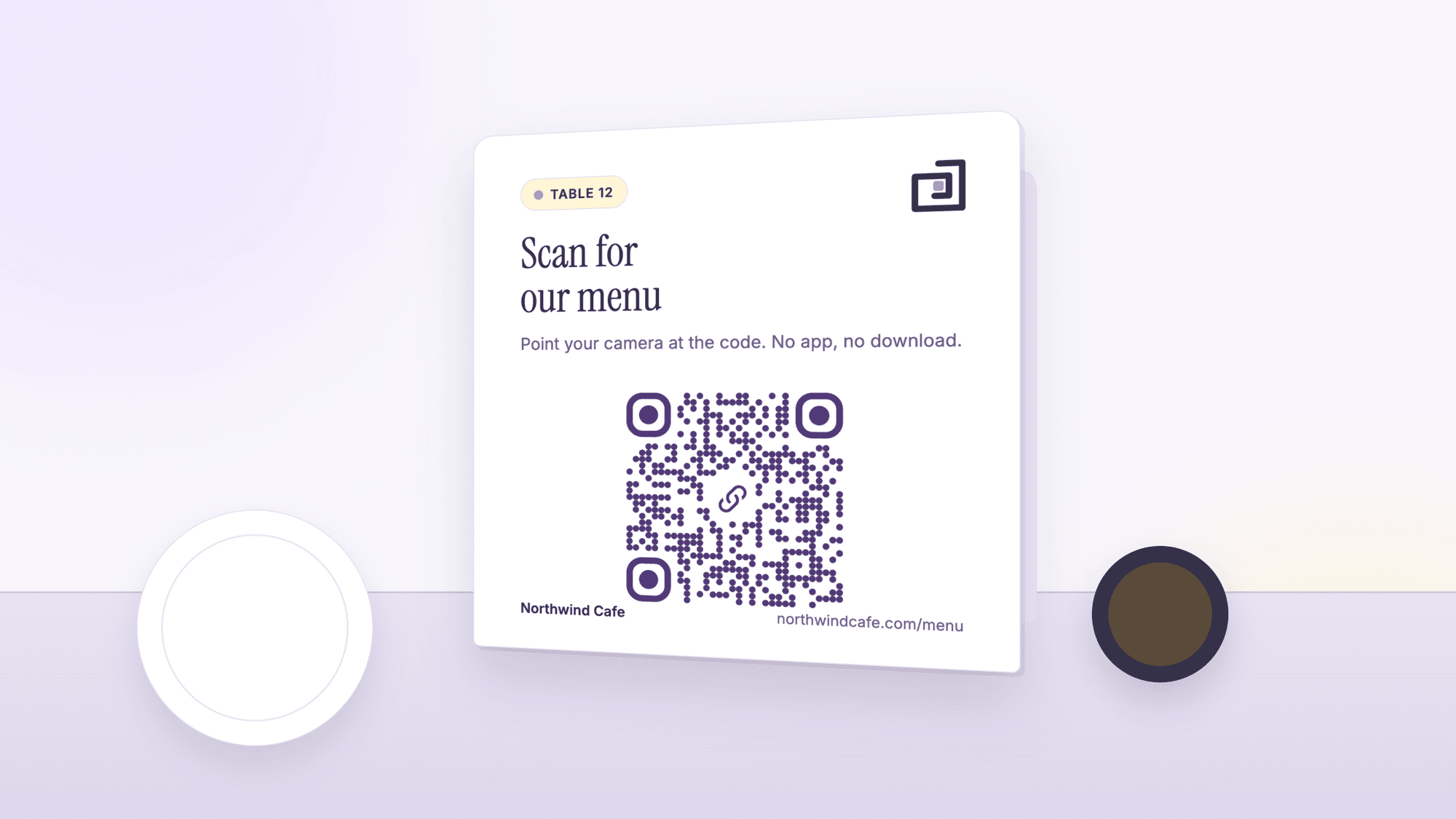
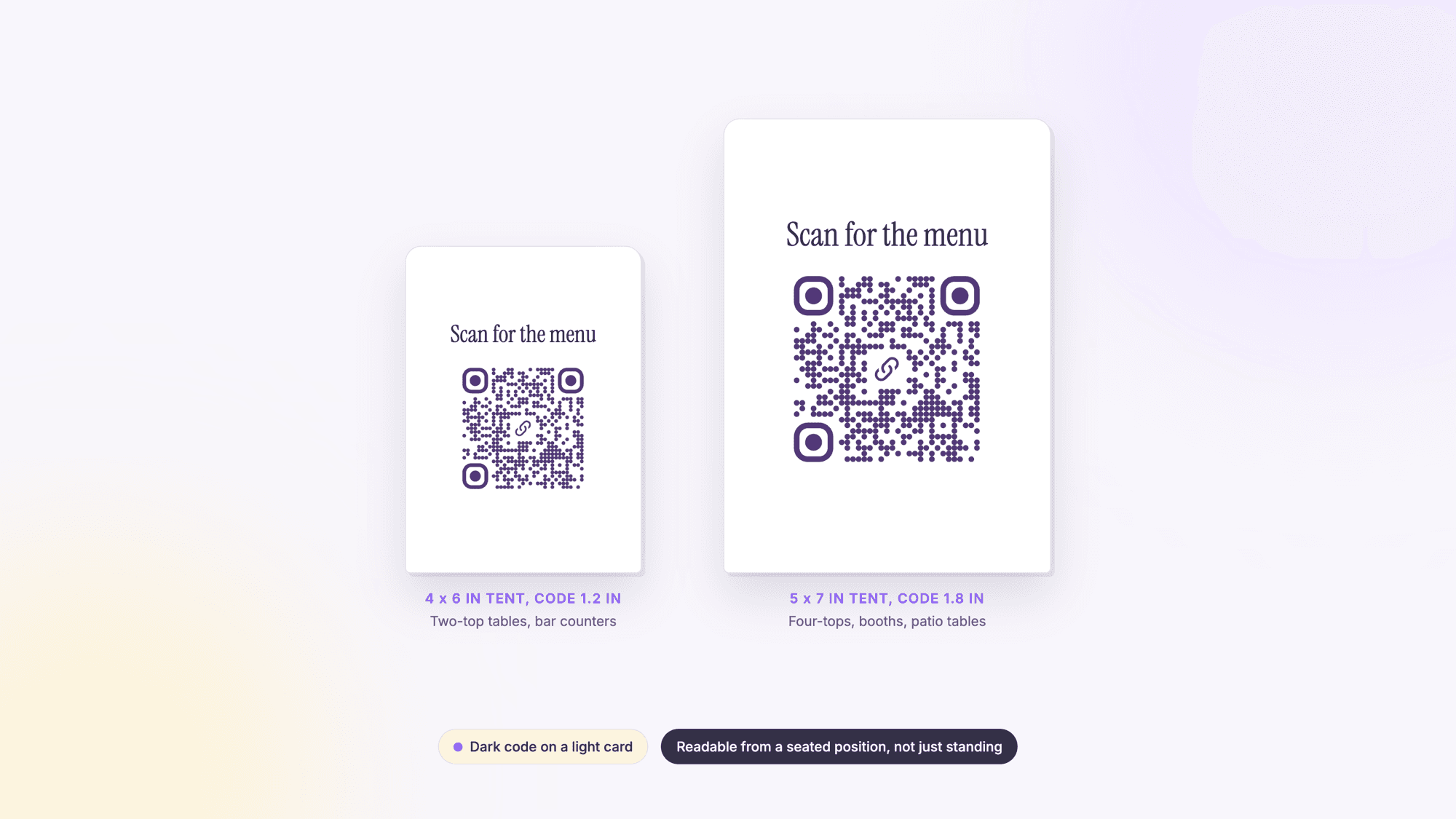
Table tent at 2 by 3.5 inches. The standard. Card stock, matte laminate so it does not glare under spot lights, QR no smaller than 2.5 cm square. Print the short URL beneath it in 8-point type. Tents get knocked over, get sauce on them, occasionally walk home in a tote bag. Budget for replacements every six months.
Table edge sticker at 1.5 by 1.5 inches. Lower profile, harder to steal, slightly harder to spot. Best for restaurants with a minimalist aesthetic where a tent looks fussy. Use a UV-cured vinyl print, not a paper sticker. Paper peels after three months of wipe-downs.
Bill closer at 3 by 3 inches. The most undervalued real estate in the restaurant. The check arrives, the meal is over, the guest is in the happiest 90 seconds they will spend with you. A 3-inch square QR on the bill folder or printed on the receipt paper itself, pointing at a single page with two buttons (leave a Google review, follow on Instagram), is the highest-converting placement you have. More on this in a moment.
Use our URL QR code generator, paste your menu URL, and download the SVG. SVG scales without pixelation, which matters when your printer wants to scale to fit a slightly different template than the one you exported for. Pair it with a Wi-Fi QR on the same tent. Two QRs, two jobs, no awkward exchange with the server about the password.
The bill QR for Google Reviews: the trick nobody uses enough
A common pattern in small restaurants: consistent five-star food, and almost no new Google reviews. The bill folder usually has a printed thank-you and nothing else. Charming. Useless for actually generating reviews.
Add a QR to the bill folder pointing to a small landing page with a short set of buttons: leave a Google review, follow on Instagram, join an email or text list. Use the direct review URL format that opens the review composer in one tap on both iOS and Android, so leaving a review takes one scan and one tap, not a search through the App Store first.
Do not gate the review button. Asking for a star rating before sending the guest to Google violates Google's review policy and can get your listing flagged. Do not put this QR on the menu and expect review lift either. The menu QR gets scanned at the start of the meal when the guest has no opinion yet. The bill QR gets scanned at the end, when they do, and a happy guest already has their phone out paying anyway.
The most common reason a scan rate quietly stays low
The single biggest, most overlooked cause of a low scan-to-view rate is page load speed, not the QR code itself. A PDF menu hosted on a slow server, or a page bloated with a hero video and six fonts, loses guests before it finishes loading. Switching the same QR sticker to point at a lightweight HTML page (or a simple tool like Notion, Google Sites, or a static page on your own domain) with nothing but the menu content routinely fixes this, because the bottleneck was never the code, it was the three seconds of spinner before the menu appeared. Check your own menu page's load time on a phone with a few bars of signal, not on your restaurant's WiFi, before assuming the QR itself is the problem.
The five mistakes that quietly kill scan rates
No fallback URL under the QR. One in eight scans fails the first time, either because of glare, an old phone, or a guest who has never scanned before. Print the short URL in 8-point under every QR. The brain is a better backup than the camera.
The page is too heavy. An autoplay video above the fold, a dozen high-resolution photos that have not been compressed, or a page built on a slow site builder will all quietly tank your scan-through rate. Guests give up before the menu finishes loading and blame the QR code, when the actual fix is a page under a few hundred kilobytes with the menu content visible immediately. Same QR sticker either way. The code was never the problem.
Locked PDF. See above. If it is a PDF in 2026, you are losing guests at the download prompt. Rebuild it.
Dynamic QR for everything. A static QR is permanent. A dynamic QR can change destination after you print, but it adds a redirect hop and needs an account (a free QRCodePrime account includes 10 for life). Use a dynamic QR only where the destination might actually change. Menu page on your own domain? Static is fine. Promotional QR for a six-week winter menu? Dynamic.
The QR does only one job. A menu QR is one job. A bill QR can do three. Always think about what the guest is doing the moment they scan, and design the page for that moment.
What I'd skip
Dynamic QRs for the main menu, unless you update it weekly. A static QR pointed at a stable URL on your own domain does the same job and never expires. Most QR platforms sell dynamic codes hard because they generate recurring revenue; on QRCodePrime they are free (10 per free account, for life), so choose them for fit, not because of the pitch. For a menu that changes seasonally, you do not need them.
Branded QR codes with the logo in the middle. They scan slightly worse, they cost more to design, and the guest does not care. Save the brand work for the table tent itself, not the QR.
Full QR ordering for sit-down service under 50 covers. Toast and Square will sell you a flow where the guest scans, orders, and pays without a server. For a 30-seat cafe, that removes the very human touch your regulars come for. Keep the human. Use the QR for the menu only.
Multi-language menus printed in three versions. One QR, one page, a small language switcher at the top. The page does the work, not the printer.
Counter service, drive-thru, and pickup
Everything above assumes table service. Counter service is different. The guest wants to read the menu before they are at the front of the line, not after. Put the QR on the door, on a small sandwich board on the pavement, and on the back of every receipt. Keep the big board on the wall. The QR is the pre-order, not the main course.
Pickup-only formats should move the QR to the bag seal sticker. Every order that walks out the door has one shot at coming back. The sticker QR points at a single page with two buttons: leave a review, reorder. It is a tiny intervention, a code that costs nothing to print and add to a bag seal you are already using, aimed at the moment a customer is holding a warm bag and thinking about dinner, not three weeks later when a generic email lands in a folder they never open.
Common mistakes I keep seeing
The pattern across every restaurant that thinks "QR menus do not work" is the same. They printed a tent with a QR that points at a PDF. The PDF takes seven seconds to load on cellular. The text is set in 8-point. There is no fallback URL. The owner blamed the diners.
The pattern across every restaurant where it does work is also the same. The QR points at an HTML page on their own domain. The page is under 300 KB. The first thing visible is the menu, not a slideshow of the chef. The bill carries its own QR pointing at a review and follow page. The owner checks the analytics on Sunday and tweaks the page on Monday.
That is the whole playbook. The restaurants hub has a sample table tent layout you can copy and a sample bill-QR landing page. The FAQ covers print sizing, contrast, and laminate choices. If you want to go deeper on tracking which menu placement generates the most scans, the full guide to QR codes for print marketing covers UTM construction and A/B testing patterns in detail.
Turning that end-of-meal moment into steady Google reviews is a playbook of its own. Our guide to the QR code for Google reviews covers the bill-QR review trick step by step.
Common questions about QR menus for restaurants
How do I make a QR code menu without using an app?▾
You do not need an app to create or to scan a QR menu. Build your menu as a webpage on Google Sites, Squarespace, or a plain HTML file on your hosting, then generate a free URL QR code here and paste the link. Your guests scan it with the native camera on any iPhone or Android from the last six years. No app install, no account, nothing to update on their end. The only thing that matters is that the page behind the QR loads fast and looks clean on a phone screen.
What size should I print a QR code for a table tent?▾
For a standard 2 by 3.5 inch table tent, the QR code should be at least 2.5 cm (about 1 inch) square. That covers most phone cameras scanning from arm's length in normal restaurant lighting. If your dining room is dim, go to 3.5 cm to give older cameras more contrast to work with. Always download the SVG version from the generator rather than the PNG, then scale it in your design file. SVG does not pixelate regardless of what size you print.
Should I use a static or dynamic QR code for my menu?▾
Static if your menu lives at a stable URL you control, such as yourrestaurant.com/menu. Update the page itself whenever the menu changes, and the QR code never needs reprinting. Dynamic if you are pointing at a URL that might change, for example a third-party ordering platform where the link shifts whenever you update your account. Dynamic codes let you swap the destination without touching the printed tent. For most owner-operated restaurants with their own domain, static is simpler, and on QRCodePrime both are free.
Will my customers need to download anything to scan?▾
No. iPhone running iOS 11 and later and Android running version 9 and later both scan QR codes natively through the built-in camera. The guest opens their camera, points it at the code, and taps the notification that appears. No app to install. The one caveat: if your menu is a PDF, Android sometimes prompts a download before opening. That one extra tap is enough friction to lose a meaningful share of guests. Build the menu as a webpage, not a PDF, and the whole flow is one tap.
How do I track which QR menu placement gets the most scans?▾
Generate a separate QR code for each placement (table tent, front door, receipt) and add a different UTM tag to each destination URL. For the table tent, the URL might end with utm_source=table-tent. For the bill folder, utm_source=bill-folder. Google Analytics or Plausible will then show you which surface generates the most scans and, more importantly, which one converts to a Google review or an Instagram follow. Dynamic QR codes (free with a QRCodePrime account, 10 for life) give you scan counts without needing UTMs, but UTM tagging in Google Analytics tells you what happens after the scan.
What happens if I change my menu? Do I need a new QR code?▾
If you host the menu at a stable URL on your own domain and simply update the page content, the QR code never changes. You edit the HTML or Notion page or Squarespace block, and every guest who scans tomorrow sees the new version. This is the main reason to host your menu on a domain you control rather than a platform that might change your URL when you update the listing. The only time you need to reprint is if the actual destination URL changes.
Free, no signup, no watermark. Print-ready PNG and SVG download.
Make your restaurant QR code nowLast updated June 2026 by Priya Sharma.
Published by
QRCodePrime Team
Guides on making, printing and scanning QR codes
Published by the team behind the free QRCodePrime generator and scanner. The example codes in our illustrations are real codes made with the generator, numbers are either computed by us or quoted from a source we name, and the sources are linked at the end of each article. Found a mistake? Email hello@qrcodeprime.com and we will fix it.