
QR Codes for Real Estate in 2026: Yard Signs, vCards, and Lead Capture That Actually Works
Last updated Jul 3, 2026
On this page
- Why yard sign info-tubes do not work anymore
- Start with a vCard QR: your contact details, one scan, zero typing
- Yard sign QRs: what to actually put behind them
- Sign placement and print specs that actually scan
- Open house QRs that pre-populate your CRM
- Tracking which signs work: the two-stake test
- Property brochures and the 3D tour
- What I'd skip
- Commercial leasing and investor decks
- Common mistakes I keep seeing
- Common questions about QR codes for real estate
The open house I shot last month was a three-bedroom in Charlotte, listed at $619,000. The agent had a clean Compass-style sign on the lawn with a QR code panel along the bottom. I scanned it out of professional habit before I went in. It threw a 404. The property had been listed twice on different platforms in the last six weeks and the QR was pointed at a Zillow URL that had since been pulled. Forty-three minutes of foot traffic that afternoon. I watched at least eleven people scan that code. Eleven dead leads, on a Saturday, with a serious buyer pool walking past.
I sold residential in Charlotte for six years before moving into proptech, and I have looked at hundreds of agent QR setups across the US. The agents who treat QR codes seriously close meaningfully more deals from cold sign traffic than agents who do not. The setup takes about an afternoon to get right and most agents never get around to it.
Why yard sign info-tubes do not work anymore
The clear plastic tube screwed to the side of a yard sign, the one stuffed with feature sheets, is a relic. Any agent who has driven their own listings on a Sunday knows the pattern: the tube runs empty more often than it runs full. The sheets get wet, fade in the sun, or get pulled by neighbors before the open house even starts. Restocking is a chore nobody actually keeps up with. The buyer who pulls up to a tube containing one warped sheet about a different property has formed an opinion about you and your listing in about three seconds.
A QR code does the same job, for free, indefinitely. The buyer scans, the brochure opens on their phone, and you capture intent data in the process. The tube goes in the garage.
Start with a vCard QR: your contact details, one scan, zero typing
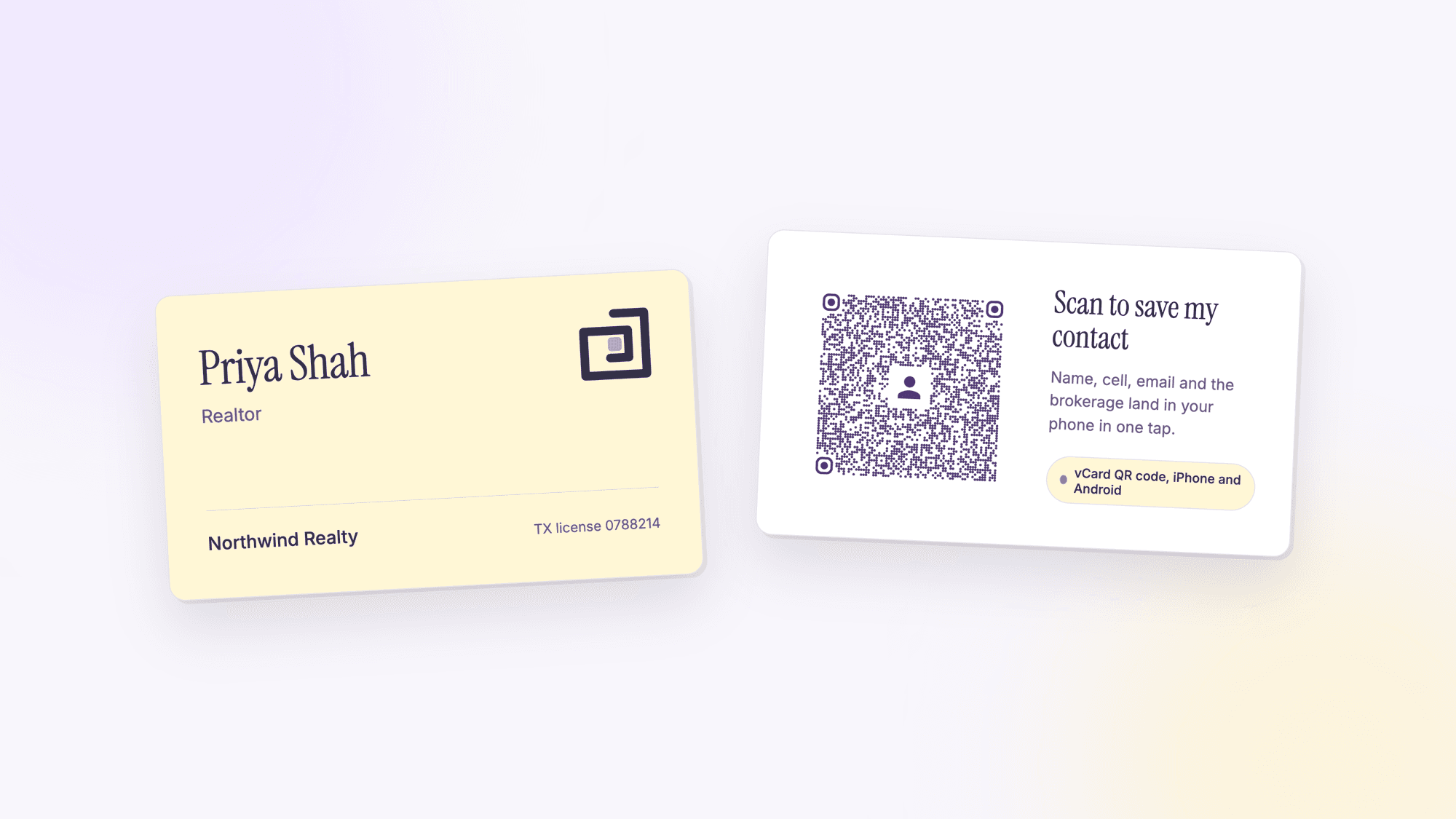
If you do nothing else this week, do this. A vCard QR encodes your name, photo, phone, email, brokerage, license number, and website into a single scannable code. The visitor scans, taps once, and you are saved into their phone contacts forever. No app required. No typing. No risk of them spelling your name wrong six months later when they are ready to list their place.
Include the license number explicitly. Buyers research agents before they call, and an agent whose business card or vCard shows the license number reads as professional. The omission reads as either hobbyist or sketchy. Compass, Coldwell Banker, and Keller Williams all train their agents to lead with license credentials in 2026. Match the bar.
Print the vCard QR on the back of every business card, sized and placed the way our business card QR guide recommends. Put a small one on every yard sign next to the property QR. Print it on every leave-behind at every showing. Use our vCard QR code generator and download the SVG. Take five minutes and do it now.
Yard sign QRs: what to actually put behind them
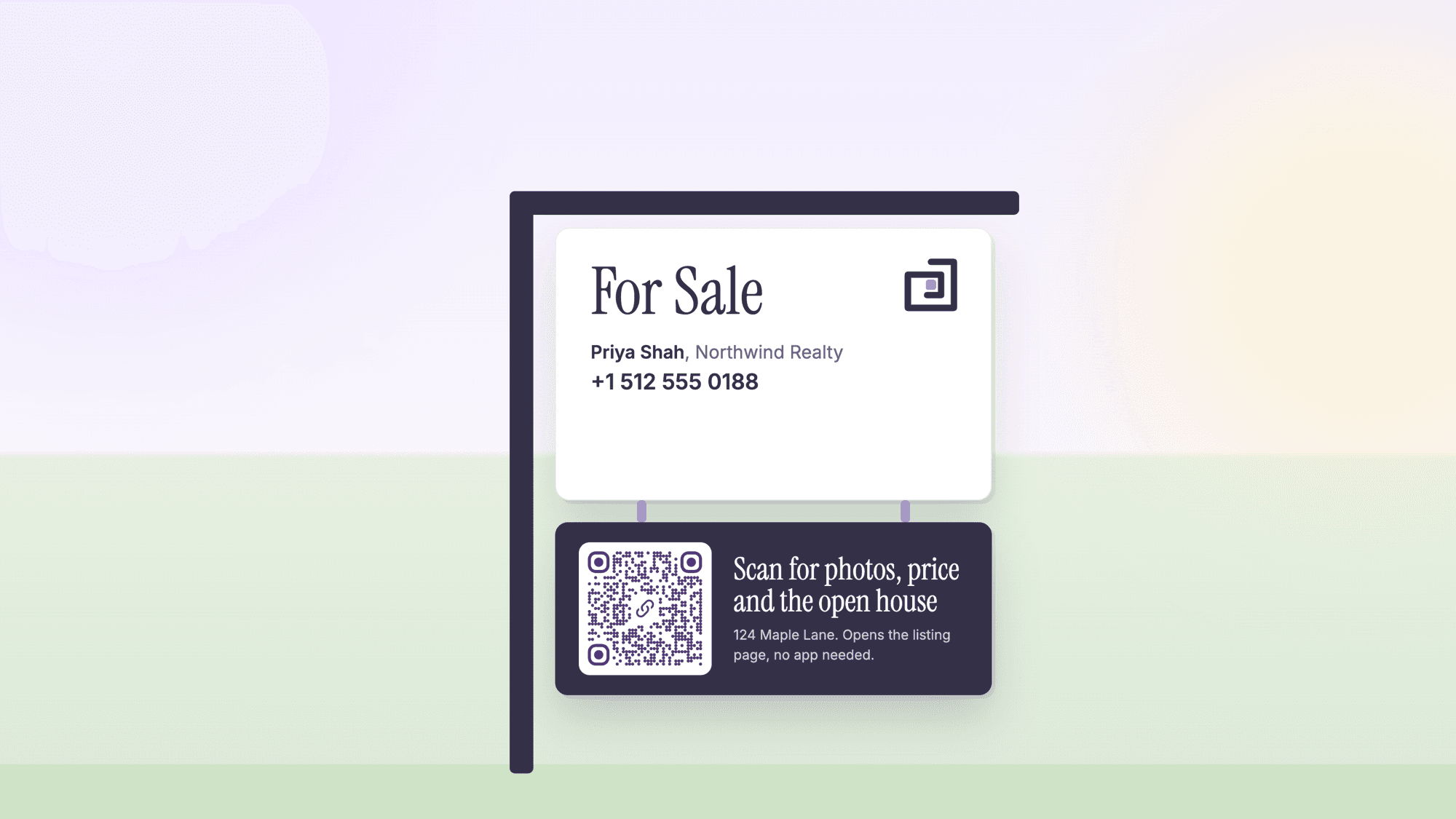
The visitor who scanned a yard sign QR already knows the address. They are standing in front of it. They want three things, in this order: more photos, the price, and a way to ask about a showing without a phone call.
Build a property landing page with exactly that. Twelve to twenty good photos at the top. Asking price visible without scrolling. A one-tap button to text you that pre-fills the message with the property address so you know which sign generated the lead. Host it on your own domain if you can. Brokerage CMSs are fine until you switch brokerages or the listing expires, at which point your sign becomes a 404 machine.
Use a dynamic QR code so when the property sells, the same code redirects to a "sold" page that pitches your services to the next person who scans. Static QRs are dead weight in real estate. Destinations always change.
Sign placement and print specs that actually scan
Put the QR on the top-right of the sign panel, not the bottom. The bottom is where dogs are at nose level and where dirt splashes after the first rain. Top-right at eye level scans cleanly from the sidewalk and from a slowly rolling car window. Test from 50 feet (15 meters) with three different phones, in three light conditions, before you sign off on a print run.
Size matters at distance. A QR meant to be scanned from the sidewalk needs to be at least 4 cm square. From a slow-rolling car, 6 cm. From across the street, 8 cm. The rule of thumb is the QR should be one-tenth of the maximum expected scan distance. Anything smaller is gambling on perfect light and a fresh phone.
Contrast is law. Black on white scans first time, every time. Dark navy on cream scans. Light gray on white does not scan, full stop. If your brokerage template uses light gray on white, override it. I have seen otherwise perfect signs go dark for an entire summer because someone in marketing chose pastel branding over scan reliability.
Print on UV-stable vinyl. Laminate matters more than the print itself. Glossy laminate reflects the afternoon sun and makes the QR unscannable between 2 and 5 PM. Matte laminate solves it for about 8 cents per sign more. Always laminate. Never print-only. A printed-only QR on a yard sign survives maybe six weeks of weather before fading.
Print the short URL beneath the QR in 12-point type. The buyer who has never scanned a QR can still type six characters into their browser. Older buyers in particular default to typing.
Open house QRs that pre-populate your CRM
The clipboard sign-in at an open house is theater. Half the visitors skip it. The ones who fill it in write their real name on a good day and Mickey Mouse on a bad one. You spend Monday morning trying to read handwriting and manually keying it into your CRM. The data is unusable.
Replace it with a QR at the entry. Scanning opens a 20-second form on the visitor's phone. Name, phone, email, and one multiple-choice question: are you actively looking, just curious, or considering selling your own place? The third option is the gold one. Visitors who tick "considering selling my own" are often four to six months from a listing conversation.
Two implementation notes. Do not ask for email if you already have phone, or vice versa. Asking for both signals you are about to add them to a newsletter. Single-channel ask, one promise of no spam in a sentence under the form, and a webhook that drops the lead straight into your CRM tagged with the property address and timestamp. No manual data entry. No friction. The form has to load in under two seconds because open houses are often in basements with terrible signal.
Tracking which signs work: the two-stake test
Dynamic QRs make signage measurable. Same listing, two yards if it is a corner lot, one QR per yard with different short codes. After 30 days, you can see which side gets scanned more. Maybe it is the side facing the school pickup line. Maybe it is the side facing the morning commuter route. Now you know where to put the open house feather flag and where to focus the neighborhood drop.
Run the two-stake test across a full quarter of listings and patterns usually surface that a gut feeling would have missed, townhouses out-scanning detached homes in one zip code, or the corner-lot side facing foot traffic beating the side facing the street two to one. None of that shows up if the QR just sits there uncounted. The moment you can see which property type or which placement pulls more scans, that becomes a real talking point in a listing pitch, not a guess.
UTM your destinations. Every yard sign QR should append utm_source=yard-sign and utm_campaign=[street-address] so Google Analytics can attribute the website visit to a specific sign. Without UTMs you are flying blind.
Property brochures and the 3D tour
Print a one-page brochure with a single QR that opens the 3D tour. A Matterport tour lets a buyer walk every room before they ever request a showing, which means the showings that do get booked are with people who already know they like the layout. Fewer wasted first showings, more serious buyers self-qualifying at the kitchen table before they ever call you.
The brochure QR should also work as the after-hours scan. Window cling QRs on the front window of the listing, scannable from the porch at 9 PM on a Tuesday by the couple who drove by to see the neighborhood, are quietly the best lead source nobody talks about. The cling stays up the whole listing period and converts the drive-by curiosity into a Wednesday-morning text.
What I'd skip
Anything that requires the prospect to download an app. The tech is real, the friction is fatal. A buyer at a yard sign on a Sunday afternoon will not install a brokerage app to see your floor plan. They will drive on. Use the web. The browser is the universal app.
QR codes on Facebook ads or other digital surfaces. The person is already on a phone. They can tap a link. A QR on a digital placement is an extra step that adds nothing.
Branded QR codes with a property photo in the middle. The scan reliability drops, and the buyer does not notice. The QR is plumbing. Make it work, do not make it pretty.
Single static QR for your entire business. One QR pointing at your homepage is a missed opportunity. You want per-listing QRs, per-sign QRs, per-open-house QRs, and one vCard QR. The cost of generating them is zero. The attribution value is everything.
Commercial leasing and investor decks
Commercial leasing in 2026 is still using phone numbers in 24-point font on window signs. The opportunity is open. Add a QR to every "for lease" sign that opens a one-page memorandum with floor plate, square footage, rent per square foot, building amenities, and a booking link. The serious tenants self-qualify before they ever call. The bargain hunters filter themselves out. Your phone rings less and the calls that come in are higher quality.
For investor pitch decks, put a QR on the last slide that opens a soft-gated virtual data room. You see who opens what. The flaky leads filter themselves out within 48 hours.
Common mistakes I keep seeing
The four patterns I see at every brokerage office I walk into.
QR points at a Zillow URL. Zillow pulls expired listings. The QR breaks. The sign stays up for two more weeks pointing at a 404. Host the page on your own domain.
No UTM parameters. The website visit shows up as "direct traffic" and you cannot tell which sign or which open house generated the lead. Tag everything.
QR is too small. 2 cm on a yard sign meant to be read from a car is wishful thinking. Go bigger.
Dynamic QR with an expired subscription. If the platform you use to host the dynamic redirect lapses, every QR you printed in the last year goes dead at once. Pick a platform whose dynamic codes never expire (every free QRCodePrime account includes 10 for life, with no renewal to miss), or self-host the redirect on your own domain.
The real estate hub has sample signage layouts and the property landing page template I recommend. For a regular URL QR rather than a vCard, the URL generator is the same flow with a different input. For the full UTM tagging and attribution setup that turns your yard sign data into a defensible budget argument, the guide to QR codes for print marketing covers every parameter and the city-vs-city A/B test pattern.
For a single one-off code, a vCard on a solo flyer with no tracking needed, the plain QR code generator on the homepage handles it in one step, no account required.
Common questions about QR codes for real estate
What information should I put behind a yard sign QR code?▾
The buyer standing at your sign already knows the address. They want three things in this order: more photos, the asking price, and a frictionless way to request a showing without calling. Build a one-page property site with twelve to twenty good photos at the top, asking price visible without scrolling, and a pre-filled text message button that includes the property address. If you have a Matterport or 3D tour, put it below the photos. Everything else is secondary. An agent bio, brokerage logo, and ten paragraphs of neighborhood description can wait for the follow-up email.
How big should a QR code be on a "For Sale" sign to be scannable from the street?▾
The rule is: QR code size in centimeters should be at least one-tenth the maximum expected scanning distance in centimeters. From the sidewalk at about 3 meters, you need at least 3 cm, but 4 to 5 cm is the practical minimum on a yard sign because the camera angle is rarely perfect. From a slow-rolling car at 5 meters, you need 5 to 6 cm. Test by standing at the actual distance with three different phones before signing off on the print run. Matte laminate only. Glossy laminate reflects afternoon sun and makes the code unscannable between 2 and 5 PM.
Will a QR code survive winter weather on a yard sign?▾
It depends entirely on the substrate and laminate, not the QR code itself. Corrugated plastic (coroplast) with a paper face and no laminate fades and warps within four to six weeks in sun and moisture. Aluminum composite with UV-stable print and matte laminate will last years. For any listing that runs through a full season, specify aluminum composite or at minimum a UV-cured vinyl print on coroplast with an over-laminate film. The extra cost is roughly six dollars per sign. A 404 from faded print costs you every drive-by buyer who scanned it.
Can I track which yard signs get the most QR scans?▾
Yes, and this is where dynamic QR codes earn their keep. Generate one QR per sign location, each pointing at the same property page but with a distinct short code or UTM tag. After thirty days you can see whether the front lawn sign or the corner lot stake gets more traffic, and whether morning walkers or weekend drivers are more likely to scan. Patterns like one property type consistently out-scanning another, or one side of a corner lot pulling more traffic than the other, only surface once you are actually tracking scans instead of guessing. The data is free. You just have to set it up before the signs go in the ground.
Should every property listing have its own QR code?▾
Yes. A single QR that points to your homepage is a missed opportunity. Each listing should have its own QR pointing at a listing-specific page, each open house should have its own QR for the sign-in form, and you should have one personal vCard QR that never changes. The cost of generating additional codes is zero. The attribution value of knowing which listing drove which lead is significant, especially for your end-of-year review of which neighborhoods or property types are generating the most cold interest.
What is a vCard QR code and why do realtors use them?▾
A vCard QR encodes your full contact record (name, phone, email, brokerage, license number, website) in the VCF standard that every smartphone understands. When a buyer scans it, their contacts app prompts them to save you with one tap, no typing, no risk of a misspelling six months later when they are ready to list their own place. Realtors put them on the back of business cards, on yard signs next to the listing QR, and on every open house leave-behind. Include your license number explicitly: buyers research agents before they call, and seeing the credential without being asked for it reads as professional rather than pushy.
Save-to-contacts QR with your name, phone, email, license number, and photo. Free, no signup.
Create your realtor vCard QRLast updated June 2026 by James Chen.
Published by
QRCodePrime Team
Guides on making, printing and scanning QR codes
Published by the team behind the free QRCodePrime generator and scanner. The example codes in our illustrations are real codes made with the generator, numbers are either computed by us or quoted from a source we name, and the sources are linked at the end of each article. Found a mistake? Email hello@qrcodeprime.com and we will fix it.